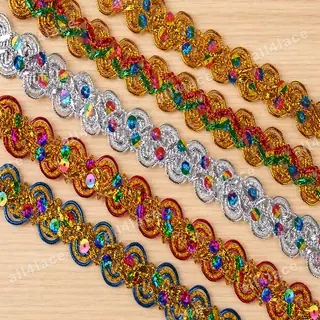
A roll length does not tell a buyer how many matched garment pieces it yields. Starts, ends, visible joins and motif alignment can consume material outside the nominal piece lengths. Plan cuts against the actual design before ordering.
Trim roll conversion: confirm motif repeat, quote unit and unstretched length
Measure several complete motif repeats and mark any section that should not form a visible starting edge. Confirm the unit on the supplier quote and measure a representative roll or sample length without stretching the band.
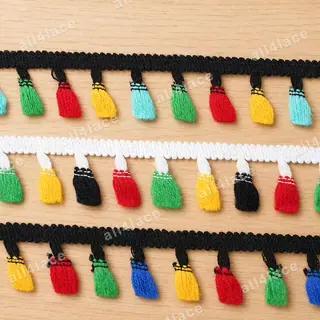
For the pictured tassel border, mark both the braid cutting line and the tassel or colour that should appear at each visible end. A tassel interval and a complete colour sequence may be different repeats. Check the exact selected strip; do not transfer a measured repeat from another strip in the photograph.
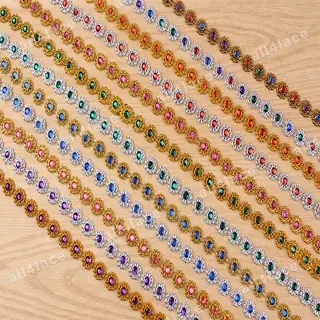
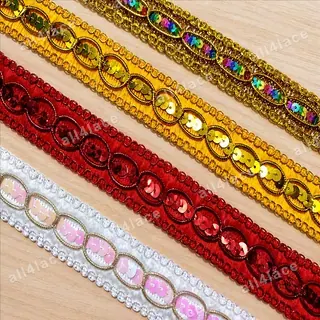
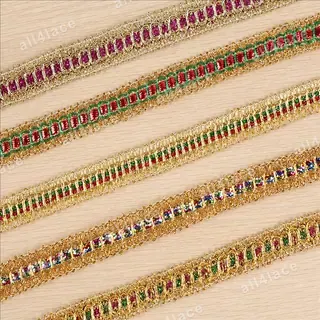
Use the trims below to choose a cutting landmark. Mark a dot on the narrow chain, a ring or an oval on the decorative bands, or a red rectangular accent on the pictured gold-edged band. Confirm the usable length and cut position on the actual sample.
Map every garment cut before totalling trim lengths
Lay out every garment part on paper in cutting order, including left and right pieces. Reserve complete motifs for front-facing ends and put allowed joins at named seams. Sum physical cut lengths and independently list only actual end or splice losses.
Keep each uninterrupted usable segment separate. Mark unacceptable joins, damaged zones and any extra clearance around them before calculating. Two short remnants cannot supply one longer unjoined piece simply because their lengths add up. Include the agreed seam or end-finishing allowance in each cut length, then avoid counting it again as a separate loss.
Worked example: the same total length can yield fewer pieces
Illustrative arithmetic only, not a specification for the photographed trim. Assume an 8.00 m roll has 0.20 m of excluded material in total and one internal break divides the remainder into two usable 3.90 m segments. Each required cut is 0.80 m, already including its end allowances. Assume no additional motif-position constraint and no permitted joins inside a cut.
Each 3.90 m segment supplies four cuts: 4 × 0.80 = 3.20 m, leaving 0.70 m. Together they supply eight cuts and two separate 0.70 m remnants. Dividing the combined 7.80 m by 0.80 m suggests nine cuts, but the ninth cannot be made without joining the remnants. Eight cuts make four garments only if each garment needs two interchangeable, approved cuts.
This example isolates the continuous-length constraint. Real tassel or colour alignment may reduce the count further. If joins are allowed, approve their location and construction, then recalculate using the required overlap or finishing allowance; do not assume the two remnants become one full-length piece without loss.
| Usable material | Complete 0.80 m cuts | Remaining lengths |
|---|---|---|
| Segment A: 3.90 m | 4 | 0.70 m |
| Segment B: 3.90 m | 4 | 0.70 m |
| Combined result | 8 cuts; 4 pairs if interchangeable | Two separate 0.70 m remnants |
Usable trim-piece records: roll length, piece count and remainder
Record a cut map, required piece count, usable roll length and any remainder that cannot form the next piece. Recalculate if a colourway has a different repeat. Do not call the roll-to-piece ratio a measured yield until a real layout has been checked.
When identical pieces have no repeat-position constraint, divide each continuous usable segment by the complete cut length, round down to a whole-piece count, then add the segment counts. If a garment needs a matched left/right pair, count approved pairs rather than loose pieces. Different cut lengths, mirrored motifs or fixed starting colours require an actual cut map; the simple division is then only an initial estimate.
Send a cutting record with the quotation request
Record the product reference and colour, quote unit, usable segment lengths, excluded zones, finished placement, full cut lengths, pieces per garment, allowed joins and motif start points. Attach a numbered sketch and retain a labelled trial pair. Keep the theoretical count separate from the accepted result after physical cutting and sewing.
Discuss your embroidery project
Send All4Lace the selected trim reference, colour, cut map and garment quantity. Ask for the offered length unit, continuous-length and join conditions, and enough representative sample material to verify the layout before bulk approval.
Contact Zhijin